Pain Management Practice Cuts Denials by 58%

BCBS placed Rosewood Pain Management under enhanced claim scrutiny after elevated denial rates signaled potential compliance and contract risk across its network.
Business Challenges
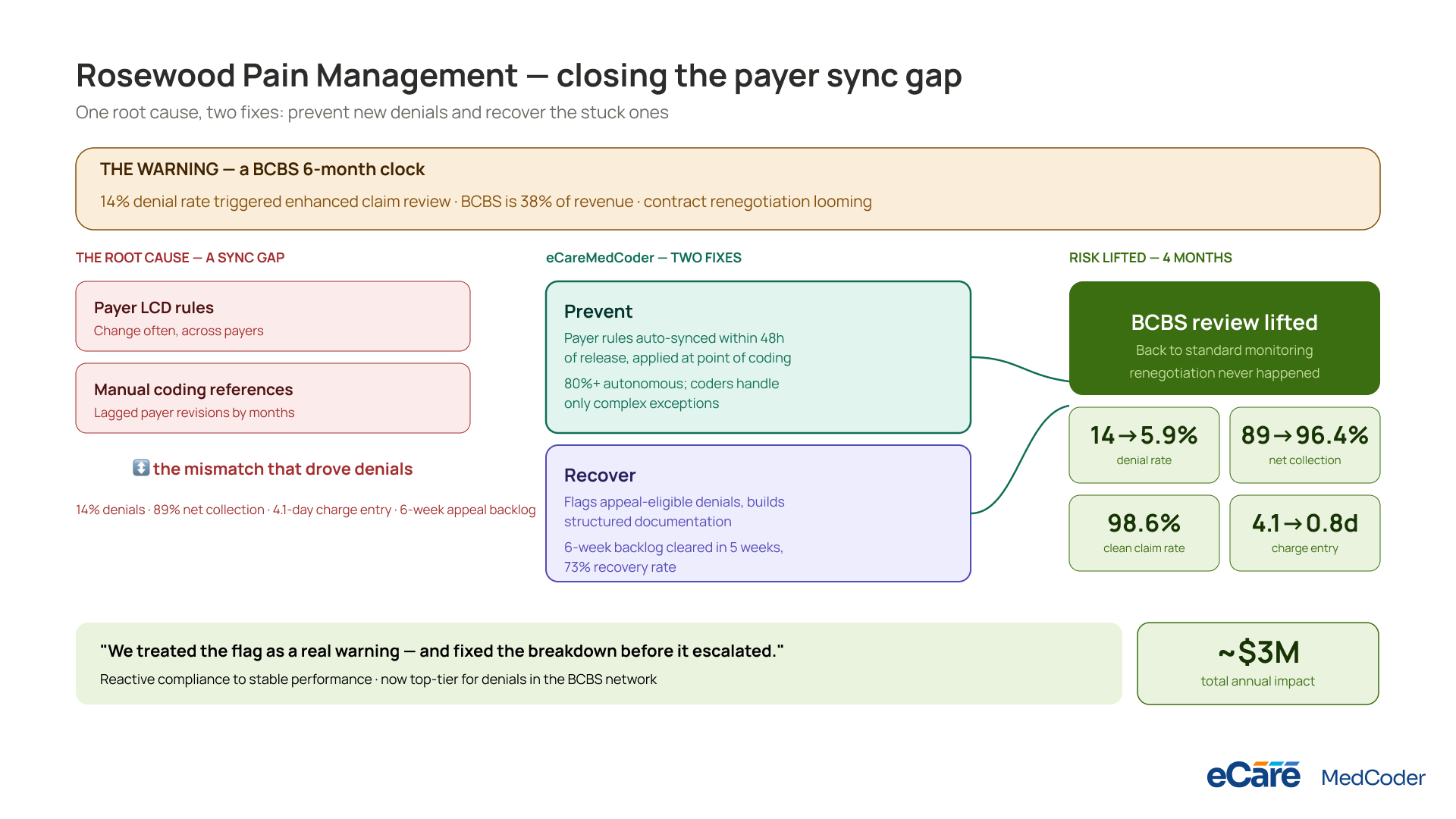
In February 2025, Rosewood Pain Management received a formal notification from BCBS escalating its claims for additional review. The payer flagged the practice’s denial performance as outside acceptable thresholds and warned that continued trends could lead to contract renegotiation within six months.
At the time, Rosewood operated as a 12-provider specialty group with high exposure to payer-specific variability in pain management billing. Local Coverage Determinations (LCDs) differed across payers and frequently changed, while Rosewood’s internal coding references were updated manually and often lagged behind payer revisions by several months. This created systematic mismatches between documentation and payer expectations.
The operational impact was already visible. Claims were taking an average of 4.1 days to move from encounter to charge entry due to coding backlog. Appeals were significantly delayed, with a six-week queue that risked missing filing windows. Overall net collection efficiency stood at 89%, well below specialty benchmarks that typically exceed 95%.
- BCBS placed Rosewood on enhanced claim review due to 14% denial rate; contract renegotiation conversations expected within 6 months.
- Pain-management procedural coding has high LCD variability across payers; coders were working from out-of-date manually-maintained LCD documents.
- Charge entry took 4.1 days post-encounter due to coder review queue depth.
- The appeal queue was backlogged 6 weeks, with high write-off risk on time-limited appeals.
- Net collection rate sat at 89% — well below the 95%+ specialty benchmark for pain management.
Solution
Given BCBS’s six-month warning window, COO Hannah Drexler prioritized a solution that could demonstrate measurable denial reduction within 60–90 days of deployment.
After evaluation, Rosewood selected eCareMedCoder for its ability to align coding decisions with real-time payer LCD updates. Unlike their prior system, which relied on static documentation, the platform continuously updated payer rules within 48 hours of release and applied them at the point of coding.
This shift ensured coding decisions reflected current payer expectations rather than outdated reference material, directly addressing the root cause of recurring BCBS denials.
A second critical capability was automated appeal handling. The platform identified appeal-eligible denials, generated structured documentation, and enabled systematic processing of backlog cases that had previously been delayed due to manual workload constraints.
Value Delivered
Within 60 days, BCBS-specific denial rates showed measurable improvement, and within 90 days, system-wide performance stabilized at significantly lower levels. The enhanced review status imposed by BCBS was lifted within four months of deployment.
- Denial rate dropped from 14% to 5.9% within 90 days of full deployment.
- Net collection rate lifted from 89% to 96.4% — exceeding the specialty benchmark for the first time in the practice’s history.
- Charge entry dropped from 4.1 days to 0.8 days; the autonomous coding workflow compressed the coder queue.
- $1.1M recovered through systematic appeal cycle; the previously-stuck 6-week backlog of appeals was worked down within 5 weeks.
- BCBS enhanced-review status lifted; contract renegotiation conversation did not occur.
Solution Provided
The deployment was completed in 10 weeks and structured specifically around BCBS risk mitigation timelines.
Weeks 1–2: BCBS-Specific Denial Pattern Analysis
The initial phase focused on analyzing one year of BCBS denial data. The analysis identified recurring failure points in key pain management procedures such as epidural injections, radiofrequency ablation, and sacroiliac joint treatments. These gaps were traced back to mismatches between outdated coding references and updated LCD requirements.
Weeks 3–5: Pilot on BCBS Encounters Only
The system was first activated exclusively for BCBS claims. This allowed direct measurement of denial reduction within the highest-risk payer segment. By week five, BCBS denial rates had already dropped from 16.8% to 8.3%, confirming early effectiveness.
Weeks 5–7: Full Payer Deployment
Following pilot success, deployment expanded across all payers. Each payer introduced slight variations in LCD rules, requiring configuration tuning. Despite this variability, autonomous coding coverage stabilized at over 80%, with human coders handling only complex exceptions.
Weeks 7–10: Appeal Workflow Activation
The final phase focused on clearing accumulated appeal backlogs. More than six weeks of delayed appeals were processed in under five weeks. Recovery rates improved to 73%, driven by faster submission timing and improved documentation quality aligned with payer review windows.
Business Value
Hannah presented the final engagement outcomes to Rosewood’s partners in summer 2025, framing the transformation as a resolution of a payer-risk issue that could have escalated into broader reimbursement pressure if left unresolved.
What the engagement preserved
The most significant outcome was the stabilization of Rosewood’s BCBS relationship. As the practice’s largest payer, accounting for roughly 38% of total revenue, BCBS posed a systemic risk if denial trends continued. Without intervention, the practice faced potential contract renegotiation that could have led to reduced reimbursement rates across its core services.
By correcting denial drivers, Rosewood effectively avoided an estimated $1.2M in annual revenue loss tied to potential rate compression and unfavorable contract adjustments.
The financial picture
The engagement delivered both immediate and recurring financial gains. Appeals recovery contributed approximately $1.1M in one-time revenue realization. Improved denial prevention added around $1.8M in annual recurring revenue through higher clean-claim performance.
Additionally, the avoided BCBS contract compression represented a further ~$1.2M in protected annual revenue.
Combined, the total annual financial impact is estimated at approximately $3M, achieved against a $240K implementation investment.
What changed about Rosewood’s payer-relations posture
Rosewood’s position with BCBS shifted from reactive compliance management to stable operational performance. The practice moved out of enhanced review status and back into standard monitoring, with subsequent payer interactions becoming routine rather than corrective.
Internally, denial performance is now consistently ranked in the top tier for pain management practices within the BCBS network, signaling a structural improvement in revenue integrity rather than a temporary fix.
“BCBS flagged the issue early, and we treated it as a real warning signal. By fixing the operational breakdown before escalation, we avoided contract pressure entirely. The platform didn’t just reduce denials — it protected our reimbursement stability. Fixing the process cost far less than the financial impact we would have absorbed otherwise.” — Hannah Drexler, COO, Rosewood Pain Management