Billing Company Reaches 96% Autonomous Direct-Bill Rate

A major enterprise RFP pushed Lakeside Medical Billing into a corner: deliver guaranteed 24-hour coding turnaround or lose a $5.2M opportunity. The CEO had to rethink the entire coding model to make it viable.
Business Challenges
Lakeside Medical Billing received a high-value RFP in early 2025 from a 14-state physician services organization managing 380 providers. The opportunity represented $5.2M in annual revenue, but came with strict contractual requirements: every encounter had to be coded within 24 hours, with penalties for missed SLAs.
At the time, Lakeside’s coding cycle was significantly slower. Standard turnaround ranged between 4–5 days, and during peak intake volumes stretched up to 10 days. Leadership quickly realized the existing workforce model could not absorb the demand increase required by the contract.
CEO Andre Polikoff analyzed hiring capacity and found a hard constraint: meeting the SLA would require around 18 additional coders. The company had already struggled for months to fill a 4-coder gap, managing to hire only one. At that point, scaling headcount was no longer a realistic path.
The operational picture reinforced the constraint. Coding cost per chart averaged $14.20, leaving limited room for margin expansion. First-pass accuracy stood at 88%, and coding-related denials were around 7%, already impacting client retention and profitability. It was clear the issue extended beyond the RFP — the entire coding model was under strain.
- Major client RFP required guaranteed 24-hour coding turnaround on every encounter; financial penalties for SLA breaches.
- Existing coding turnaround averaged 4–5 days during normal volume and 7–10 days during peak periods.
- Meeting the new SLA at client volume required 18 additional coders; local labor market produced 1 hire against a prior 4-coder gap in 8 months.
- Coding cost per chart sat at $14.20; pricing pressure from existing clients was compressing margin.
- First-pass coding accuracy averaged 88%; coding-related denial rate sat at 7%.
Solution
Andre’s approach was shaped by urgency: the RFP decision window was only 90 days. Any solution had to demonstrate real production capability within that period, not theoretical improvements.
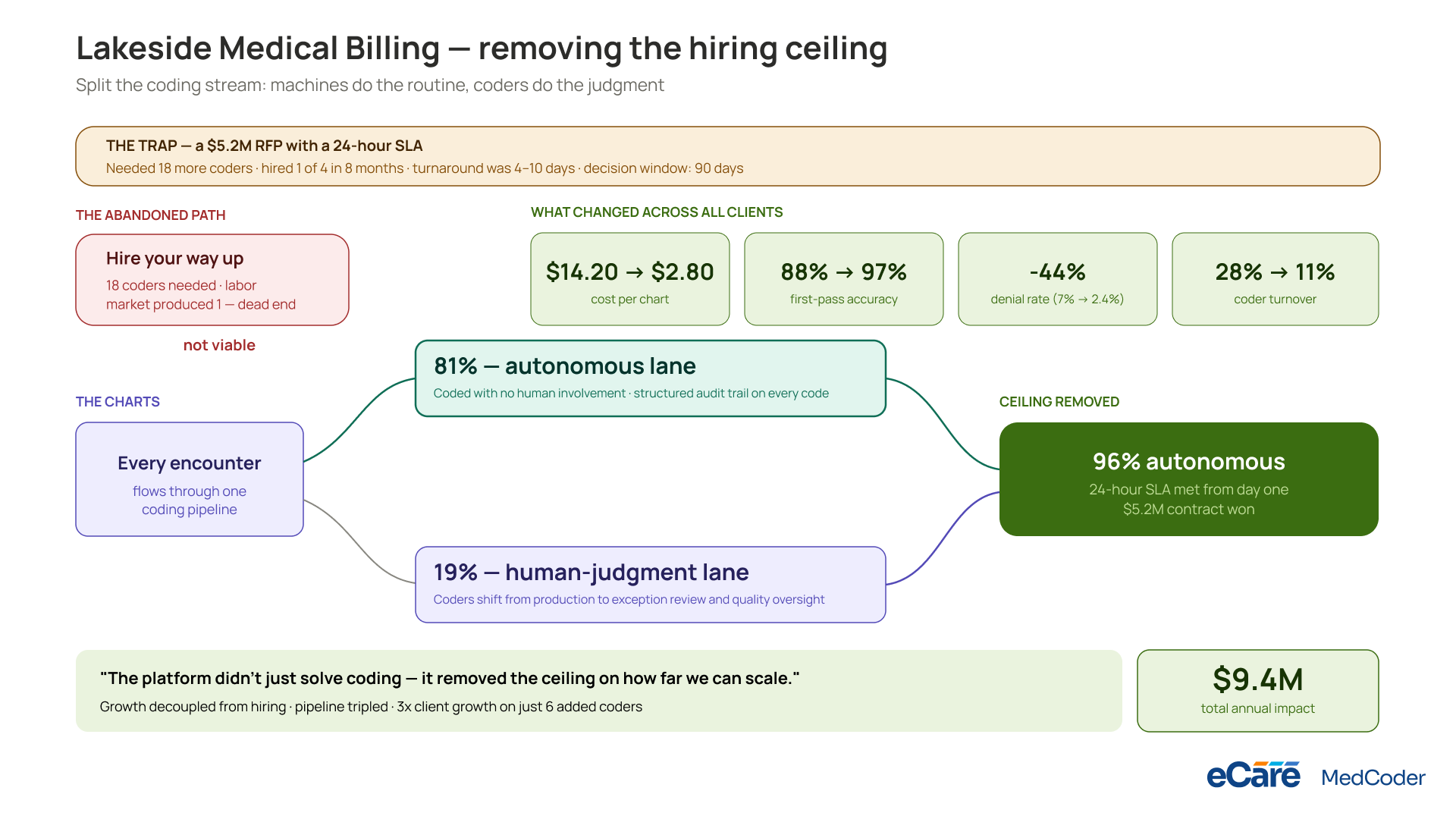
After evaluation, Lakeside selected eCareMedCoder following a 30-day proof-of-value using real client charts. The system successfully automated coding for approximately 81% of encounters without human involvement. The remaining 19% consisted of complex or ambiguous cases routed to human coders for review.
This hybrid model proved critical: it showed Lakeside could meet the 24-hour SLA without expanding headcount. The platform effectively decoupled growth from hiring constraints.
A second factor influencing the decision was audit defensibility. Each code generated by the platform included a structured reasoning trail — linking clinical evidence, coding guidelines, and decision logic. This made documentation significantly stronger and more defensible under payer or CMS audit scrutiny compared to traditional manual workflows.
Value Delivered
Lakeside ultimately secured the $5.2M contract, with operations going live on schedule in early 2026. From day one, the 24-hour SLA was consistently met.
Beyond the new contract, the transformation improved overall enterprise performance. Coding throughput accelerated across all clients, not just the new RFP account, and denial rates declined across the board.
- Per-chart coding cost dropped from $14.20 to $2.80; the structural cost reduction enabled the new RFP economics.
- Coding backlog dropped from 4–5 days to under 24 hours across all clients (not just the new RFP).
- First-pass coding accuracy lifted from 88% to 97%; coding-related denial rates dropped from 7% to 2.4%.
- 3x client-base growth absorbed without proportional coder headcount; Lakeside hired 6 additional coders over 18 months against the prior trajectory of needing 24+ additional coders.
- $5.2M annual RFP contract won; the contract Lakeside would have had to decline became the foundation for the next two years’ growth.
Solution Provided
The deployment was completed over 11 weeks and designed around parallel outcomes: enabling the new RFP go-live while restructuring the existing coding operation.
Weeks 1–3: Platform Integration with Lakeside’s Existing Coding Workflow
The platform was embedded into Lakeside’s current coding pipeline without disrupting client-facing processes. Clinical documentation flowed through existing intake systems, while coding outputs fed directly into billing workflows. The transition was intentionally seamless for clients, ensuring continuity during adoption.
Weeks 4–6: Pilot on Existing Client Volume
During the pilot phase, roughly 18,000 records were processed. The system consistently automated 81% of coding tasks. Human coders focused exclusively on complex or edge cases requiring clinical interpretation, shifting their role from production to validation and quality oversight.
Weeks 6–8: Coder Workflow Migration and Role Repositioning
Coder roles were gradually redefined. Instead of high-volume manual coding, teams now handled exception review and adjudication of ambiguous cases. While initial resistance emerged, compensation adjustments for senior coders helped align incentives with the upgraded skill requirements.
Weeks 9–11: New Client Onboarding Preparation
The final phase focused on configuring specialty-specific logic for the incoming client across 12 high-volume specialties. By the end of week 11, the system was fully prepared for go-live, ahead of contractual requirements.
Business Value
Andre presented the engagement results to Lakeside’s board at the end of fiscal 2026. The framing was that Lakeside had repositioned its operational model in a way that fundamentally changed the company’s growth trajectory.
What changed about Lakeside’s growth thesis
Lakeside’s prior growth ceiling had been coder availability. The autonomous coding capability removes that ceiling. Lakeside is now bidding on RFPs the company would not have credibly bid on previously, including larger physician services organizations and hospital-based billing contracts. The company’s pipeline has tripled in the 12 months following deployment.
The financial picture
The $5.2M new RFP contract is the immediate revenue impact. The per-chart cost reduction across the existing client base represents approximately $2.4M in annualized margin improvement. The deferred hiring cost (24+ coders that would have been needed at the prior trajectory) represents approximately $1.8M in annual operating cost avoided. Total annual financial impact: approximately $9.4M against a $480K implementation cost.
What changed about the coders’ work
Lakeside’s coding team was repositioned rather than reduced. The team’s daily work is now higher-judgment work, supported by the platform handling the routine production coding. Coder retention has improved (turnover dropped from 28% to 11% in the 18 months following deployment) because the work has become genuinely engaging rather than rote.
“We had a choice between rejecting growth because we couldn’t hire fast enough, or redesigning the workflow so growth wasn’t constrained by hiring at all. The platform didn’t just solve coding, it removed the ceiling on how far we can scale.” — Andre Polikoff, CEO, Lakeside Medical Billing